Condition Guide · Atlanta, GA
High hamstring tendinopathy sits right where the hamstring attaches to the base of the pelvis — the "sit bone." It is the runner's and rower's ache that gets worse with sprinting, lunging, and, frustratingly, with sitting on a hard chair. When it becomes chronic, the tendon at that attachment has broken down rather than simply strained.
Real Results
High hamstring tendinopathy is among the conditions TenJet addresses. This patient describes their own tendon procedure.
TenJet Patient Testimonial
Video courtesy of HydroCision, Inc., the maker of TenJet®. Individual results vary; this patient's experience is not a guarantee of outcome. Talk with a specialist about whether the procedure is appropriate for you.
Understanding The Condition
The proximal hamstring tendon anchors to the ischial tuberosity — the bone you sit on. Compression against that bone is part of why long drives and hard chairs aggravate it, and why it can be so slow to settle. Like other chronic tendon problems, it is a matter of disorganized, weakened tissue with limited blood supply, not ongoing inflammation.
Where TenJet Fits
A progressive loading program is the backbone of treatment for high hamstring tendinopathy, and it resolves many cases. When the tendon stays symptomatic, TenJet — a HydroCision, Inc. device — offers a specialist a way to treat the degenerated tissue in the office, without an open surgical approach to a deep, awkward area.
See The Procedure
A general demonstration of how TenJet works from HydroCision, its maker, plus a look at how a chronically degenerated tendon differs from one that is simply inflamed. The same principle applies across the tendons TenJet is used to treat.
TenJet Patient Animation — How the Procedure Works


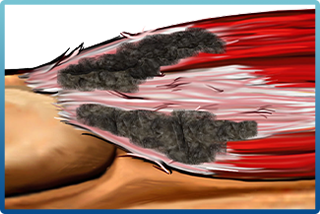
Diagrams and video courtesy of HydroCision, Inc.
Common Questions
Degeneration of the hamstring tendons where they attach to the sitting bone. It typically produces deep buttock pain that is worse when sitting or during sprinting.
Sitting compresses the tendon against the bone it attaches to. That compression pattern is characteristic and helps distinguish it from other causes of buttock pain.
Frequently — for sciatica, piriformis syndrome or a lumbar problem, since the pain sits in a similar region. Imaging and examination are what separate them.
Through the same percutaneous, ultrasound-guided approach used for other chronic tendinopathies: a small incision, local anesthetic and targeted removal of the degenerated tissue.
This information is general and is not medical advice. Whether any procedure is appropriate for you can only be determined by a physician who has examined you and reviewed your imaging.